There are many approaches to reuse in software engineering. Among
them, patterns hold a prominent position. "Each pattern describes a
problem which occurs over and over again in our environment, and then
describes the core of the solution to that problem, in such a way that
you can use this solution a million times over, without ever doing it
the same way twice" (Alexander, 1979).
We are interested in the use of
patterns for the requirements analysis stage, namely Software
Requirement Patterns. The patterns applicability to this context is
clear, since requirements that appear over and over in requirements
books could be identified as the solution to particular problems in a
given context (the classical context-problem-solution scenario of
patterns).
In the PABRE framework we have currently defined a software requirements pattern catalogue with 66 patterns: 29 to be applied as non-functional requirements and 38 as non-technical ones. The catalogue is currently evolving to add functional patterns of certain software domains and also more specific patterns on information security.
The patters are available under a creative commons license schema (CC 3.0 BY-NC-ND) that restrict some usages.. For other specific agreements do not hesitate to contact us. Also relevant information can be found in the post Interested in Improving your Requirements Engineering Process: Try Requirement Patterns!.
Showing posts with label Industry Collaboration. Show all posts
Wednesday, February 27, 2013
Wednesday, December 12, 2012
Interested in Improving your Requirements Engineering Process? Try Requirement Patterns!
As explained in previous posts, the we are interested in the validation of our PABRE approach and the tools that support it.
What do we want from industry? We distinguish three different collaboration scenarios, depending on the desired interaction among all the parties and the exploitation of the offered assets:
- Free experimentation. For organizations interested on exploring our framework. We would provide demo versions of the catalogue and the tool, the method and off-line training support. The organization will be allowed to use these assets for an established period of time. At the end, the organization will fill a feedback form (short questionnaire) and present in a 2-hour wrap-up meeting.
- Guided experimentation. For organizations interested on using our framework in a specific project without any modification. We would provide the catalogue, the tool and the method and a 4-hour training to the project team. The organizations will be allowed to use the assets for an established project, and during it we will provide support under request and agreed terms. At the end of the project there will be an assessment meeting and an assessment report of the experience will be written by the organization. Also the requirement book resulting from the project will be made available to us.
- Assets customization. For organizations that want to customize our assets for their specific context. The scope both in domain and time will be negotiable. The assets to customize may be:
- The catalogue, both by: a) including new patterns or modifying the existing ones, b) changing the shape that a pattern may take (e.g., to link requirement patterns to test suites or test strategies),
- The tool, adding or modifying existing functionalities or import/export capabilities (e.g., to export the requirements to some requirement management tool),
- The method, by thinking on a specific context of use.
Friday, November 23, 2012
PABRE-Proj use during Requirements Elicitation
Here we include a video presenting the process of use of PABRE-Proj tool during a Requirements Elicitation meeting. This process has been simplified in some aspects in order to facilitate the comprehension of the tool use.
PABRE-Proj may be used through a browser or using a client program. It is part of the PABRE System.
Friday, November 9, 2012
PABRE System How to Contribute
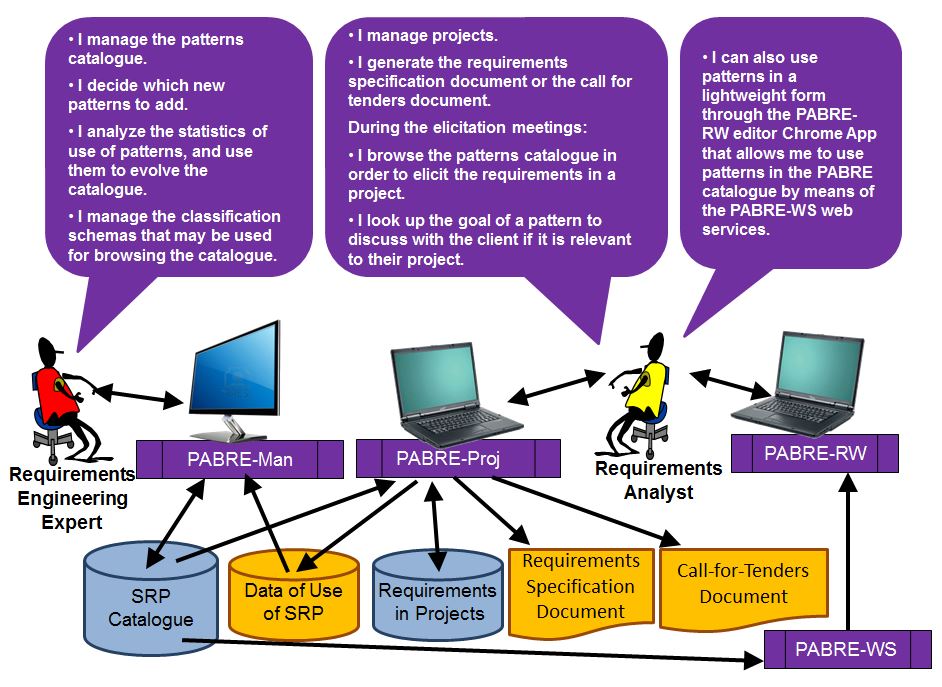
The PABRE software system is a support for the PABRE framework. It is composed by two tools: PABRE-MAN and PABRE-PROJ.
PABRE-MAN is a tool that can be used by the requirement manager of the catalogue to maintain and evolve the software requirement patterns (SRP) catalogue. Its main functionalities are: patterns management, browsing, importation/exportation, printing and catalogue evolution.
PABRE-PROJ is a tool that can be used by requirements analysts during the elicitation of requirements in a software development project, use of external software components, or acquisition of software systems. Its main functionalities are: project management, browsing, importation/exportation, requirements management document generation, or call for tenders document generation and patterns use statistics exportation. Currently, there is also a web version of this tool, in a way that requirements analysts can access and edit software requirements projects from everywhere.
The following slides were used during the last GESSI Pizza Day. They describe the projects open to students that are interested to contribute to the PABRE development.
PABRE-MAN is a tool that can be used by the requirement manager of the catalogue to maintain and evolve the software requirement patterns (SRP) catalogue. Its main functionalities are: patterns management, browsing, importation/exportation, printing and catalogue evolution.
PABRE-PROJ is a tool that can be used by requirements analysts during the elicitation of requirements in a software development project, use of external software components, or acquisition of software systems. Its main functionalities are: project management, browsing, importation/exportation, requirements management document generation, or call for tenders document generation and patterns use statistics exportation. Currently, there is also a web version of this tool, in a way that requirements analysts can access and edit software requirements projects from everywhere.
The following slides were used during the last GESSI Pizza Day. They describe the projects open to students that are interested to contribute to the PABRE development.
Thursday, October 25, 2012
Requirements Elicitation using Software Requirement Patterns
Requirements elicitation is the process of acquiring system requirements from system stakeholders. The quality of this process is critical to make information technology (IT) projects a success.
When a company runs many elicitation processes over time, it is often the case that a significant proportion of requirements is recurrent and belongs to a relatively small number of categories, especially in the case of Non-Functional and Non-Technical requirements. Capitalizing on knowledge acquired in previous projects seems in this way an adequate strategy to improve the quality of requirements, and then increase the changes of project success; as well as to increase the efficiency of the requirements elicitation process. Our PABRE framework proposes an application of the concept of software requirement pattern as a means to capture and capitalize requirements knowledge in the context of IT systems and services procurement projects.
Currently our framework includes:
·
A metamodel that describes the
structure of patterns and the catalogue.
·
A method for the process of use
of the catalogue in the requirements engineering stage.
·
Two tools (see below) helping in the use,
management and evolution of the catalogue.
·
A software requirement patterns (SRP) catalogue with 29
Non-Functional SRP and 37 Non-Technical SRP. These two catalogues are
generic and apply to every kind of software domain (although of course every
domain may have in addition some particular NF-reqs and NT-reqs). We are also interested in the construction of Functional SRP for several domains as for instance: Content Management Systems (CMS) or Cloud Computing and specifically in Software as a Service (SaaS).
We have defined several collaboration scenarios, but we are open to other collaboration ideas. If you are interested just contact us.
Try Requirements Patterns!
Software Requirement Patterns
Requirements Patterns Tools Support
PABRE System: How to contribute?
Subscribe to:
Posts (Atom)